
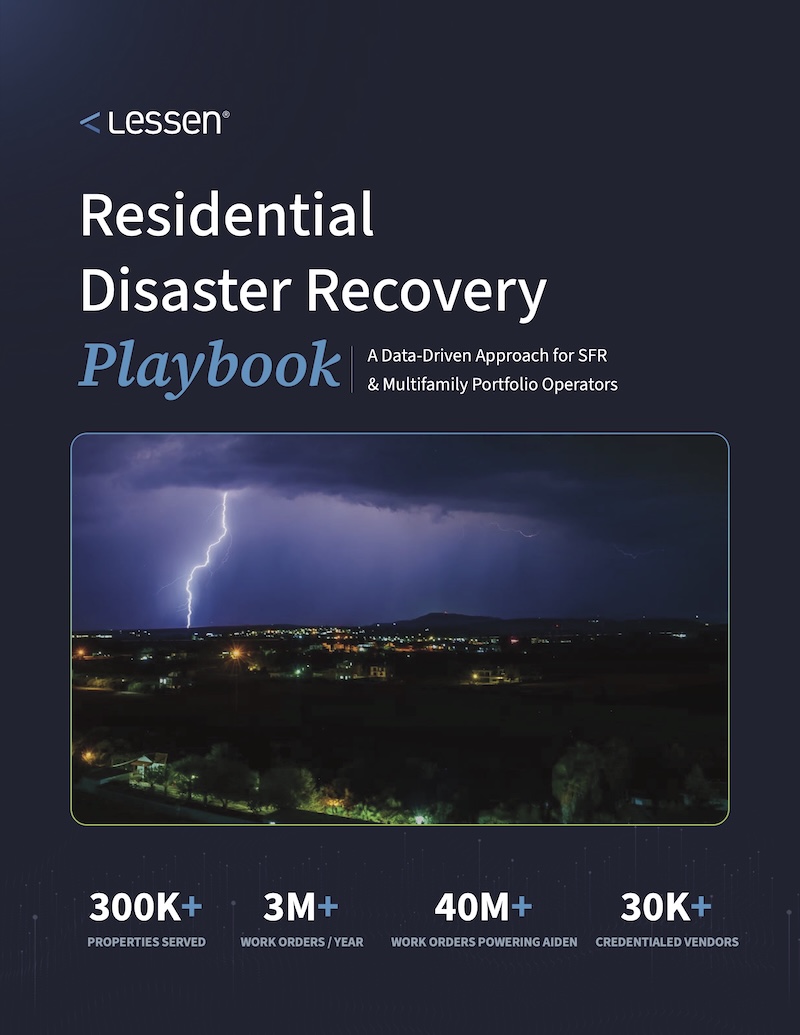
Residential Disaster Recovery Playbook
For SFR and multifamily operators, disaster response rarely fails because of the storm itself. It fails when vendors are sourced after demand spikes, when properties are assessed with regional averages instead of asset-level data, and when documentation is assembled after the fact instead of built into the response in real time.
This playbook lays out the operational infrastructure that separates portfolios that recover in days from those still coordinating vendors two weeks later: pre-staged vendors, centralized triage, a defined 48-hour mitigation standard, and resident communication protocols.
What's Inside?
A closer look at what's covered
- Seasonal checklists for Spring (pre-cooling), Summer (peak cooling), Fall (pre-heating), and Winter (heating season) aligned to when systems face peak stress
- Tasks organized into Critical Performance, Efficiency & Lifecycle, and Reliability & Risk categories for clear prioritization every season
- Recommended maintenance frequencies tied to seasonal demand cycles, including filter change intervals and condensate drain inspection cadences
- What to prioritize during seasonal transitions — the highest-risk windows when heating and cooling components exchange priority
- How to use extended system runtime as an early warning signal for airflow restrictions, refrigerant imbalance, and component wear
Key Takeaways:
What portfolio operators take from this resource
- Spring and Fall are the two highest-value intervention windows — full preventative maintenance at each seasonal transition is the baseline for reducing reactive exposure
- Reactive HVAC failures during peak demand are rarely sudden, they develop from unresolved performance issues that compound under sustained runtime
- One Lessen-managed national retail portfolio using a structured PM program saw 37% fewer comfort-related service calls and 65% of work completed proactively
- A checklist standardizes the task layer. Consistent outcomes across a portfolio require centralized coordination, standardized execution, and asset visibility alongside it
- 133,000+ labor hours executed proactively across one portfolio, driving 17% fewer sites requiring reactive service during peak season
A closer look at what's covered
- The residential response framework from pre-event risk flagging through recovery and capital planning
- Why the 48-hour mitigation window is the single most consequential variable in residential disaster response, and how to protect it
- A breakdown of the top five residential-specific failure modes, including reactive vendor sourcing and extraction-only water mitigation that misses mold prevention
- Resident communication protocols for pre-event, during-event, and post-event messaging, built for portfolios managing dozens of properties at once
- The insurance documentation standard that connects what happened, when it happened, and what was done in response, for faster settlements and fewer disputes

What SFR and multifamily operators take from this resource
- One in every 67 insured homeowners files a water damage or freezing claim each year, with an average payout of $15,400
- Mold can begin growing within 24-48 hours of water exposure, and remediation costs average $1,100-$3,400 per project when that window is missed
- 90% of U.S. natural disasters involve flooding, and between 1996 and 2019, 99% of U.S. counties were affected by a flooding event
- Multifamily property insurance premiums in 2024 were double those of 2021, more than six times the rate of CPI growth over the same period
- Aiden has driven over 600 work orders avoided across Lessen-managed portfolios through self-fix guidance, directly reducing dispatch volume during surge periods
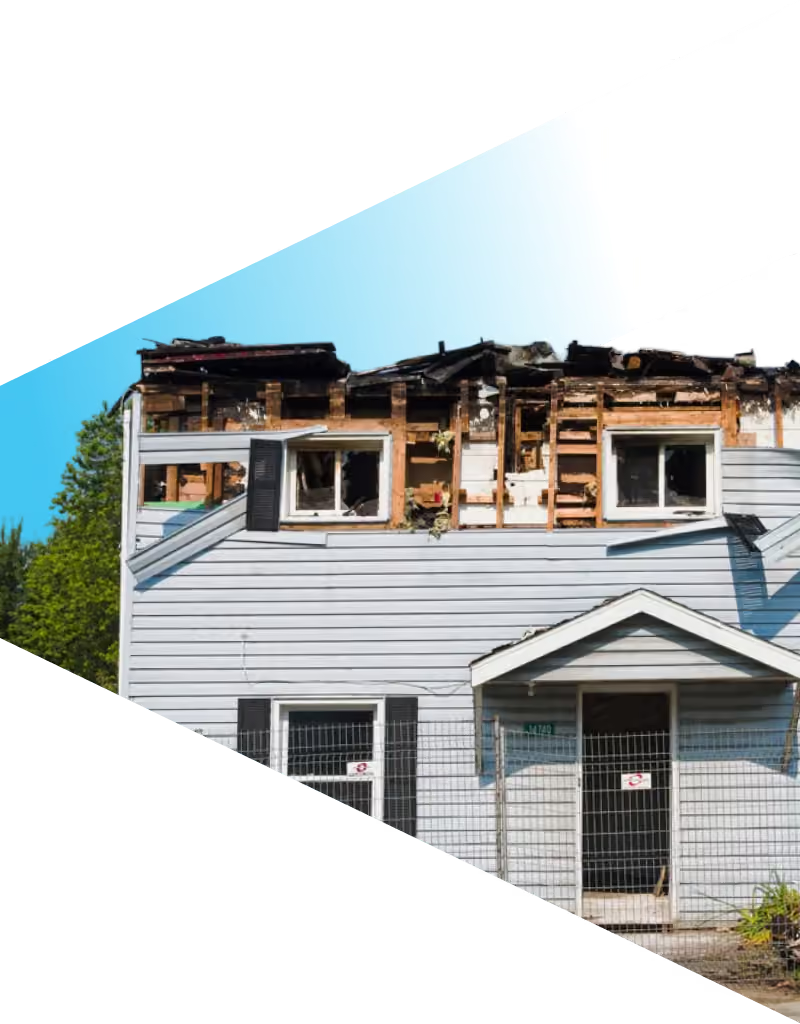
Download PlaybookResidential Disaster Recovery

Download Playbook: Residential Disaster Recovery
This playbook is built for SFR and multifamily operators managing dozens or hundreds of properties across scattered addresses, where a single regional event can generate concurrent work orders at 30, 50, or 100 locations at once.
It connects pre-event risk flagging, a defined 48-hour mitigation standard, resident communication protocols, and insurance documentation into a single operational framework, so response scales with the portfolio instead of breaking down under volume.
When paired with a broader preventative maintenance strategy, it shifts work out of reactive cycles and into planned, controlled execution.