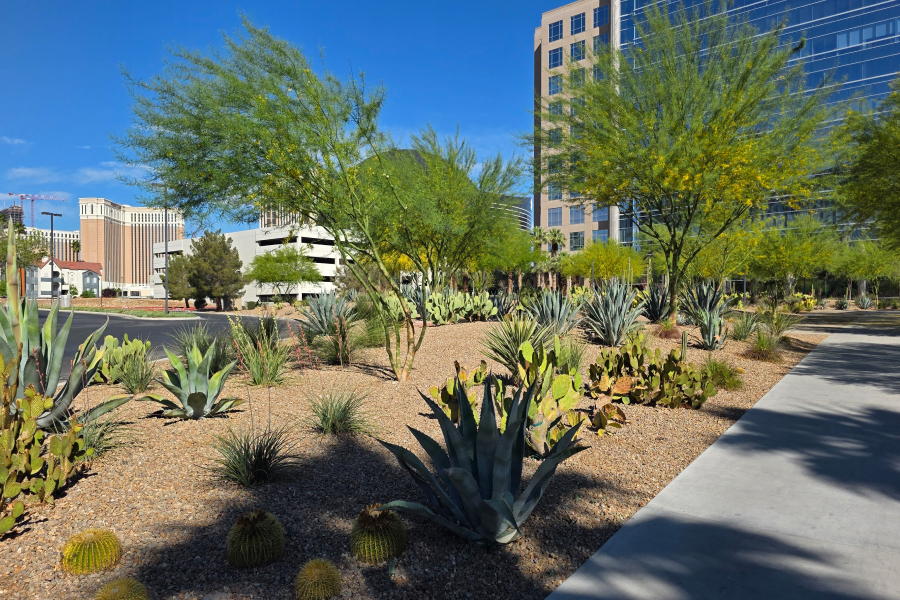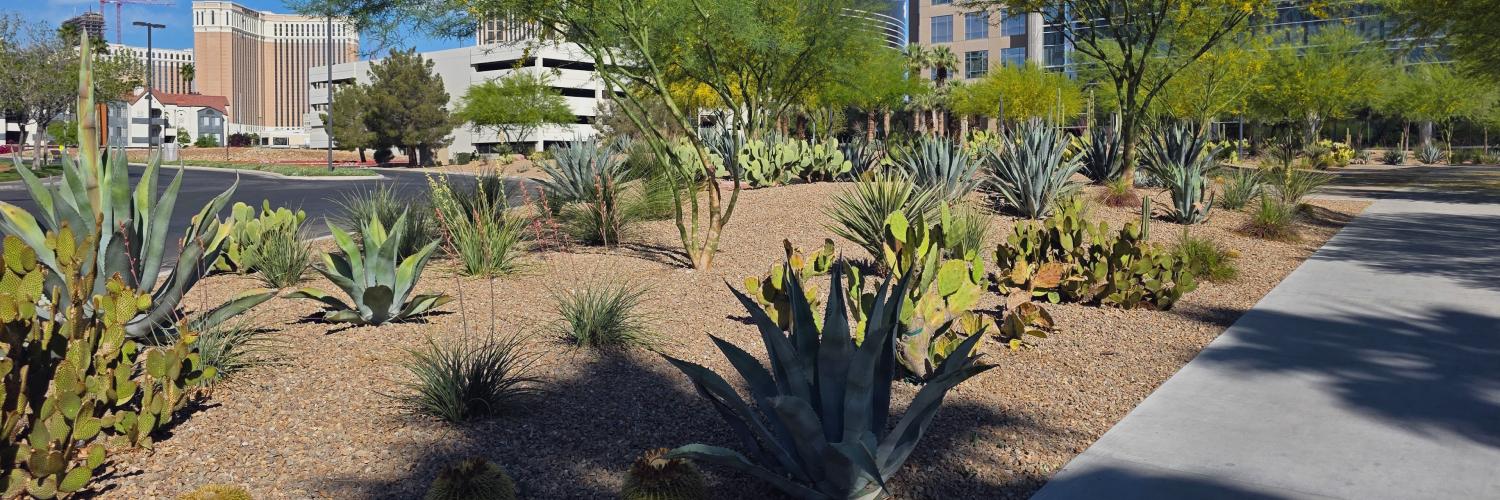
For years, drought-tolerant landscaping was a choice that commercial property owners made for cost or sustainability reasons. In a growing number of markets, it's now a requirement with a deadline.
Southern Nevada's deadline to remove nonfunctional turf from commercial properties is December 31, 2026. Starting January 1, 2027, new federal guidelines cut Colorado River deliveries to Arizona, California, and Nevada by 1.25 million acre-feet a year. And California's statewide ban on watering nonfunctional turf with drinking water reaches commercial, industrial, and institutional properties on January 1, 2028.
For a portfolio with locations in several of these markets, drought-tolerant commercial property landscaping has become a compliance schedule. This post explains what's changing, and lays out a step-by-step plan to manage it across every site. (For the case for xeriscaping itself, see our earlier post, Navigating Extreme Heat: Low-Maintenance Landscaping Solutions for Commercial Properties.)
What's changing, and when
- Southern Nevada (December 31, 2026). Nevada's AB 356 bars Colorado River water from being used to irrigate nonfunctional turf on property that isn't zoned for single-family homes. The Southern Nevada Water Authority is responsible for carrying it out, and existing nonfunctional turf must be removed by December 31, 2026.
- The Lower Colorado River Basin (2027 and 2028). In August 2026, the U.S. Department of the Interior issued operating guidelines that cut deliveries to the Lower Basin states by 1.25 million acre-feet in each of the next two years. Under the states' proposed sharing agreement, Arizona would absorb 760,000 acre-feet a year, California 440,000, and Nevada 50,000. Local water providers decide how those cuts reach their customers, which may include tighter watering rules or rate changes in affected markets. And even if winter rain eases drought in some areas, as NOAA's winter outlook suggests, the supply cuts and the watering rules tied to them stay in place.
- California (January 1, 2028). AB 1572 bans the use of potable (drinking) water to irrigate nonfunctional turf. Local government properties were first, starting January 1, 2027. Commercial, industrial, and institutional properties follow on January 1, 2028. Starting in 2030, properties with more than 5,000 square feet of irrigated turf will also have to certify compliance with the State Water Resources Control Board every three years.
Outside these markets, many cities and water districts in drought-prone regions already enforce assigned watering days and seasonal restrictions, and those rules tend to tighten during dry years.
Water rules are only one of the shifts affecting commercial grounds this year. For the bigger picture, including heavier rain, storm debris, and how to plan the 2027 season around changing weather, download our guide, Changing Weather, Changing Grounds.
Functional vs. nonfunctional turf: the distinction that drives your plan
These rules don't ban grass. They target turf that's purely decorative. Water agencies generally treat turf in medians, parking lot islands, streetscapes, and commercial frontages as nonfunctional. Turf that people actually use for recreation or gathering is usually considered functional.
That distinction matters for commercial properties, because most turf at retail centers, branches, clinics, and restaurants is the decorative kind. California's law also restricts drinking water specifically, so turf irrigated with recycled water isn't covered. Each site needs to be assessed against its local definitions.
A five-step drought-tolerant plan for multi-site portfolios
- Inventory every site. Record irrigated turf area, whether it's functional or nonfunctional under local definitions, the water source (potable or recycled), and the irrigation system type. Most portfolios don't have this data in one place, and you can't build a plan without it.
- Group sites by deadline and risk. Southern Nevada sites come first. California commercial sites follow before 2028. Arizona and other Colorado River-dependent markets should plan for tighter watering rules starting in 2027. Everything else gets a lighter-touch review.
- Set a regional plant and design palette. Choose a standard set of drought-tolerant plants, mulch, and hardscape for each climate zone. That keeps conversions consistent across locations and protects your brand's curb appeal. (See Why Brand-Consistent Landscaping Matters More Than You Think.) Plan to protect mature trees: when turf comes out, trees often need their own irrigation so they don't lose the water they were getting from the lawn.
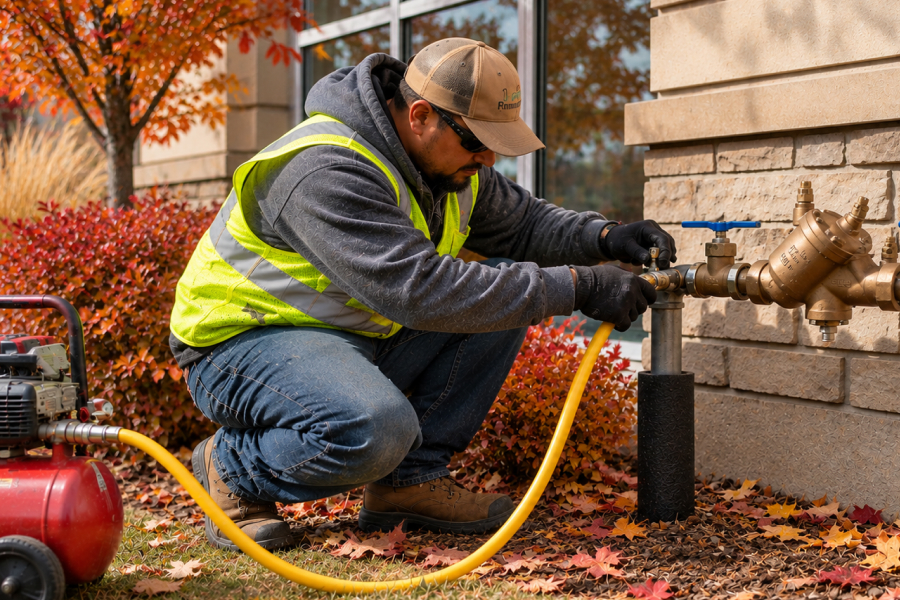
- Fix the irrigation before you replace the plants. The EPA's WaterSense program estimates that as much as 50 percent of outdoor irrigation water is wasted to overwatering caused by inefficient methods and systems. Audits, leak repairs, drip conversion in planting beds, and weather-based controllers can cut use quickly. In one WaterSense case study, an office complex in Dallas cut its irrigation water use by about 40 percent after an irrigation audit and a switch to a weather-based controller. That's why commercial irrigation services belong in the plan from the start, not as an afterthought.
- Use rebates, phase the work, and update the maintenance contract. Many water utilities offer turf-replacement and irrigation-equipment rebates for commercial customers, so check local programs before you budget. Then phase conversions by deadline and update each site's commercial property landscape maintenance scope to match the new landscape.
What commercial property landscape maintenance looks like after conversion
Drought-tolerant landscapes still need maintenance, just a different kind. Mowing visits drop, while bed care, weeding, pruning, mulch refreshes, and drip-line inspections become more important. New plantings also need closer watering and monitoring during their first season while they get established. Mulch does more of the work in a drought-tolerant landscape, too, helping beds hold moisture and protecting plants. See how Lessen rolled out a portfolio-wide mulch program for a national financial services client.
That shift should show up in your contract. Visit frequency, scope, and pricing need to change with the landscape, otherwise you're paying for mowing you no longer need while missing the bed and irrigation care that keeps the new design healthy. (See our guide to commercial landscape maintenance pricing.)
How Lessen helps
Lessen helps multi-site operators plan landscaping around drought restrictions, water conservation mandates, and local codes in every region where they operate. With ONE by Lessen, conversions and ongoing maintenance run as one program: seasons are planned in advance, services are photo-verified, compliance is tracked, and the whole portfolio is covered by one contract and one invoice. Local vendors stay close to the sites they serve, so they know regional plants, water rules, and conditions, with Lessen's standards and oversight on top.
Want to plan your portfolio around water rules, storms, and changing weather? Download the guide: Changing Weather, Changing Grounds.
Ready to put it on the calendar? Schedule your 2027 season plan.
Sources
- California State Water Resources Control Board, Nonfunctional Turf Law (AB 1572): https://www.waterboards.ca.gov/conservation/nonfunctional-turf.html
- City of San José, Nonfunctional Turf Ban AB 1572 (deadlines and self-certification): https://www.sanjoseca.gov/your-government/departments-offices/environmental-services/water-utilities/drinking-water/water-efficiency/outdoor-water-use-rules-for-businesses/nonfunctional-turf-ban
- Nevada Legislature, AB 356 (2021), bill summary: https://www.billtrack50.com/billdetail/1350976
- U.S. Bureau of Reclamation, "Interior Department Finalizes Plans for 2027-2028 Colorado River Operations" (Aug. 21, 2026): https://www.usbr.gov/newsroom/news-release/5392
- U.S. EPA WaterSense, Labeled Controllers: https://www.epa.gov/watersense/watersense-labeled-controllers
- U.S. EPA WaterSense, "Curbing Water Waste" commercial case study (Granite Park, Dallas): https://19january2017snapshot.epa.gov/www3/watersense/docs/ws_irrigationcontrollers_commerciallandscape_508.pdf
- NOAA, "El Nino looms large over U.S. Winter Outlook" (Oct. 15, 2026): https://www.noaa.gov/news-release/el-nino-looms-large-over-us-winter-outlook
Ready to see it in action?
Tell us how your portfolio runs today, and we'll show you exactly where Lessen fits.