Data Collection & Reporting
Every work order becomes an operating input
Lessen captures work order, spend, location, trade, vendor, and performance data across every job and turns it into reporting you can act on; for budget cycles, vendor management, and capital planning; built on 20+ years of operating history and 40M+ work order records.

Most portfolios don't have a data problem. They have a reporting problem.
Work order, spend, and vendor data exists; it's just scattered across invoices, vendor systems, and regional spreadsheets that don't talk to each other. Executive teams end up making budget and capital decisions without a consistent view across trade, location, or vendor.
Lessen turns execution activity into structured, reportable data as a byproduct of doing the work, not a separate reporting project layered on top.
PROGRAM SCOPE
Portfolio data, structured for decisions, not just storage
Every completed work order adds to a single, consistent record, not another system to reconcile.
Work Order & Spend Data Capture
Every service event (cost, trade, location, vendor, outcome) is captured consistently, so spend can be analyzed the same way across every market.
Trade & Vendor Performance Reporting
Patterns by trade and vendor surface clearly, showing where cost, quality, or speed is out of line with the rest of the portfolio.
Location-Level Benchmarking
Individual sites and regions can be compared on a consistent basis, turning "does this location perform well?" into an answerable question.
Executive & Budget-Cycle Reporting
Reporting is structured around the cadence real budget and planning cycles run on, not a raw data export someone has to build a report from.
Photo & Completion Documentation
Every job carries documented, photo-verified completion records, giving reporting a factual backbone instead of self-reported status.
Capital Planning Inputs
Historical spend, asset condition, and performance data feed directly into capital and budget planning models.
Reporting is only as good as the data behind it
A dashboard is only useful if what feeds it is accurate. Lessen's reporting is built on 20+ years of operating history and 40M+ work order records; captured, verified, and structured the same way across every job, every market, every vendor. That's the difference between a self-serve analytics tool you have to build queries in and reporting that's already organized around how your business actually runs.

Captured at every work order
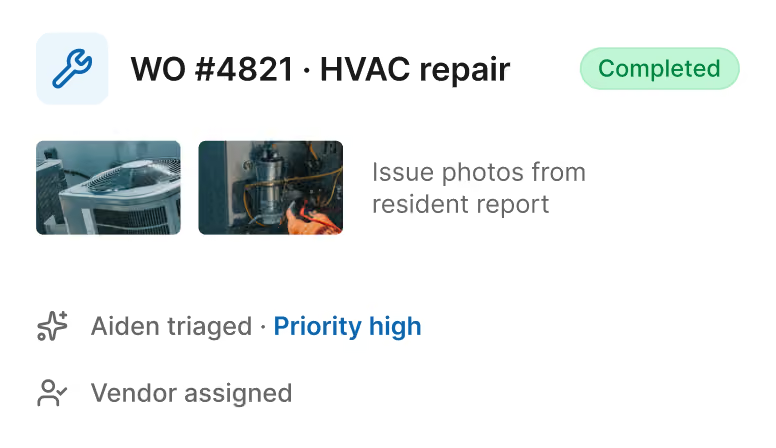
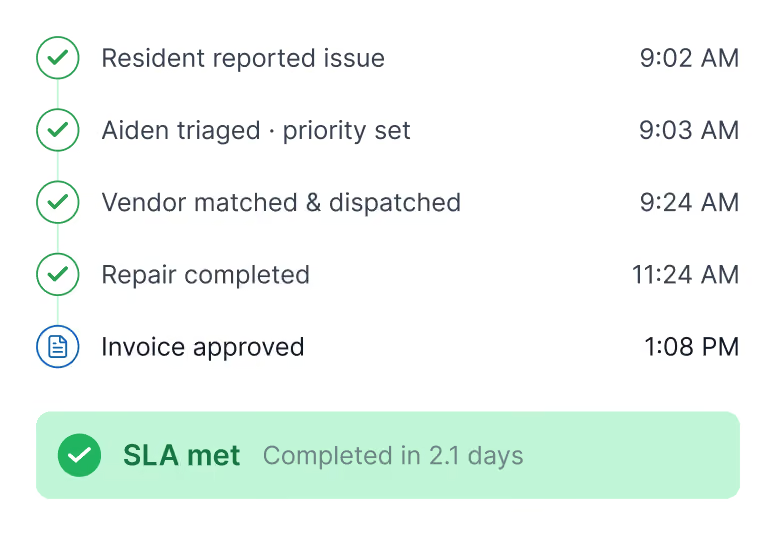
Spend, location, trade, and vendor data are logged consistently as part of completing the job, not entered separately afterward.
Verified before it's reported
Photo-verified completion and documented outcomes back the numbers, rather than relying on self-reported status.
Structured for comparison
Data is organized the same way across every market and vendor, so location- and trade-level comparisons are actually apples-to-apples.
Intelligence where reporting decisions get expensive
Structured from the first report
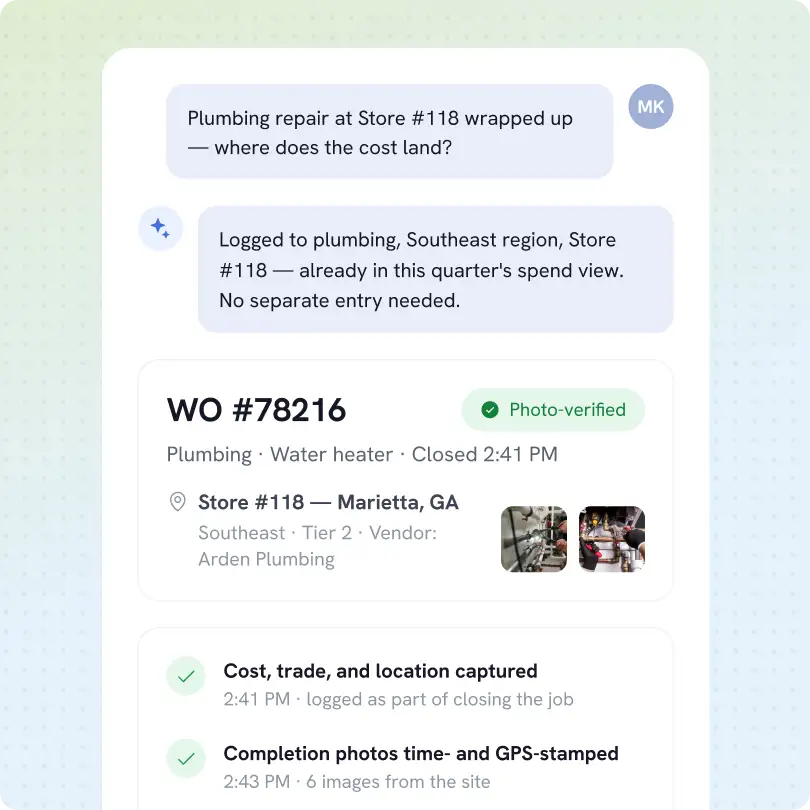
Aiden, Lessen's intelligence, helps classify each work order (capital spend, recurring maintenance, or one-off repair) and route it to the right cost, asset, and location record based on trade, site, vendor, and spend history.
Capital decisions backed by data
Aiden tracks each asset's condition, lifecycle stage, and spend history, so capital planning inputs are grounded in documented portfolio data, not a spreadsheet assembled at budget time.
Clean spend data at the source
Aiden reviews every invoice and proposal against fair-market pricing before approval, flagging over-billing and scope creep so the spend data feeding your reporting is accurate from the start.

Reporting programs built around how each portfolio operates
.jpeg)
Store-level performance is hard to compare when every location's data lands in a different vendor invoice or spreadsheet format.
.jpeg)
A portfolio spanning multiple property types needs one consistent record, not a different reporting format for every asset class.
.jpeg)
Comparing performance across units and properties only works if every work order gets captured the same way, everywhere.
.jpeg)
Board members ask for a clear answer on spend and vendor performance, but that's hard to give when the numbers live in three different systems.
.jpeg)
Multi-location clinic operators need a consistent read on spend and vendor performance across every site, not a manual roll-up before every budget review.
CUSTOMER STORY
From Spreadsheets to Data: Modernizing Work Order Management for a Health Care Retailer
Challenge
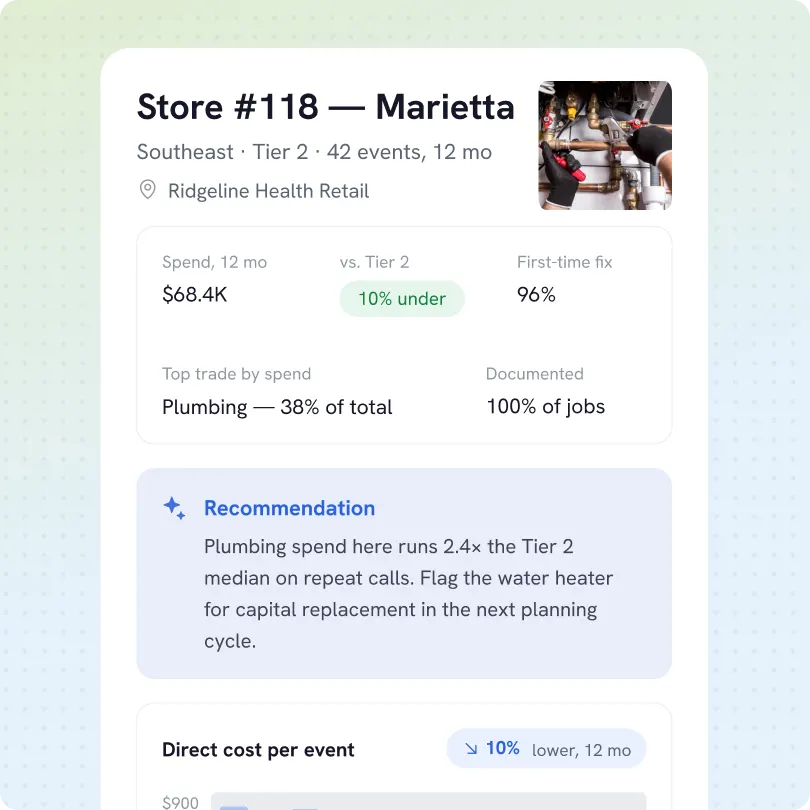
This health care retailer, operating hundreds of locations, tracked work orders by phone, email, and spreadsheet, with no consistent data or asset information. An expensive existing software tool stored lease documents but captured no usable work order data, and no consistent maintenance standards existed to confirm timely completion, schedule adherence, or accurate billing.
Solution
Lessen centralized work order creation and tracking through One by Lessen™, with GPS-verified, timestamped photo documentation on every job, converting work orders into hundreds of actionable data points, with portfolio analysis and performance benchmarking, and running quarterly business reviews to prioritize locations and surface cost-avoidance opportunities.

10%
lower direct work order costs across the portfolio
73%
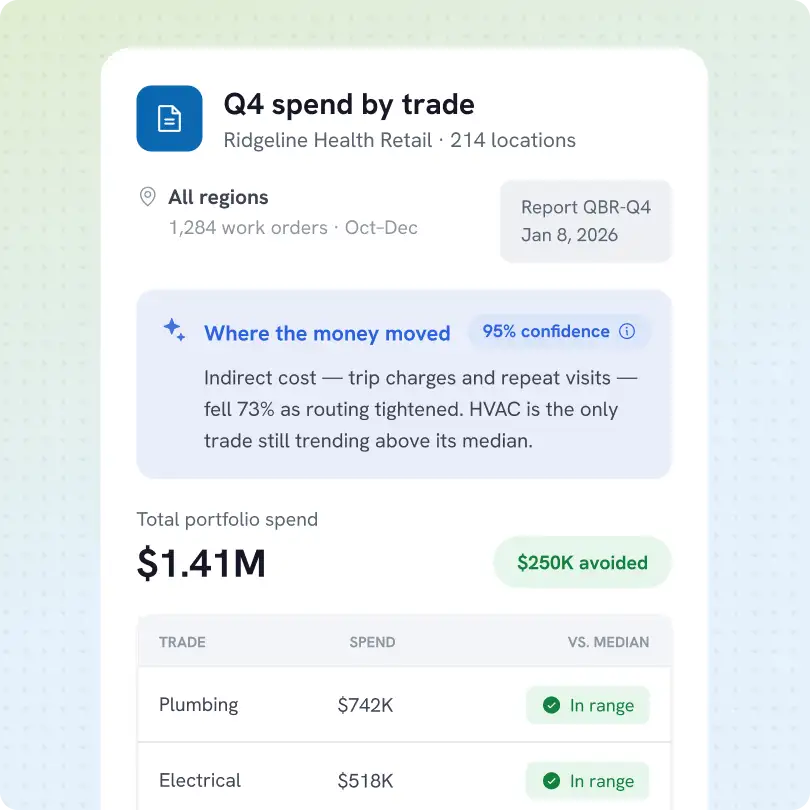
reduction in indirect costs
(trip charges, process inefficiency, management overhead)
$250K
in annual savings recovered by retiring inefficient legacy software spend
Frequently asked questions
What data does Lessen actually capture, and where does it come from?
Can this replace our current spreadsheet or BI reporting process?
How far back does the historical data go?
Do we need to change how our team tracks things internally to use this?
Get in touch with our sales and support teams for demos, onboarding support, or product questions.
Turn execution data into decisions, not spreadsheets
Let's build a reporting program around how your portfolio actually operates.