If your commercial irrigation maintenance plan is still “get to it before the first freeze,” this is the year that assumption gets tested. NOAA’s 2026-2027 Winter Outlook favors a warmer, wetter winter for much of the country, driven by a strong El Niño. For facilities teams managing landscaping across dozens or hundreds of sites, that forecast can read as permission to relax the shutdown schedule. It shouldn’t.
This Winter’s Outlook: Why “Milder” Doesn’t Mean “Safe”
According to NOAA’s official winter outlook, forecasters expect above-normal temperatures across much of the country, with wetter, stormier conditions favored in the South as a reshaped jet stream tilts the odds toward more active storms there. That’s useful for planning labor and timing, but it describes the season on average, not any single site. NOAA’s own outlook makes the point directly: a more stable polar vortex lowers, but does not eliminate, the odds of the cold-outbreak events that bring sudden freezes.
An irrigation system does not fail because of the average temperature. It fails because of the one night nobody planned for. A system that has not been fully shut down is exposed the moment the temperature drops below freezing, regardless of what the season does on either side of that night. That is the risk this post addresses: the single event most shutdown schedules are built to miss.
What Commercial Irrigation Services Should Cover Before Winter
Commercial irrigation services done right go well beyond turning off the water. A proper shutdown has specific, checkable steps, and “we winterized it” means little without them.
Blowout versus manual drain is the first decision point. A compressed-air blowout forces residual water out of lines, heads, and valves, and is standard for long runs, multiple zones, or low points where water pools. A manual drain can be adequate for simple, well-graded systems, but leaves more room for trapped water in dips. The right call depends on system design, not habit.
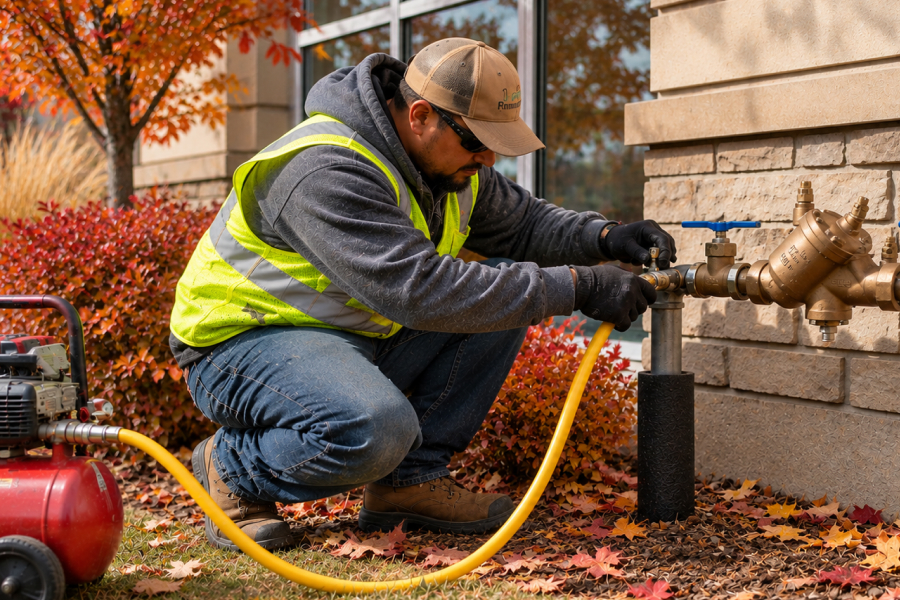
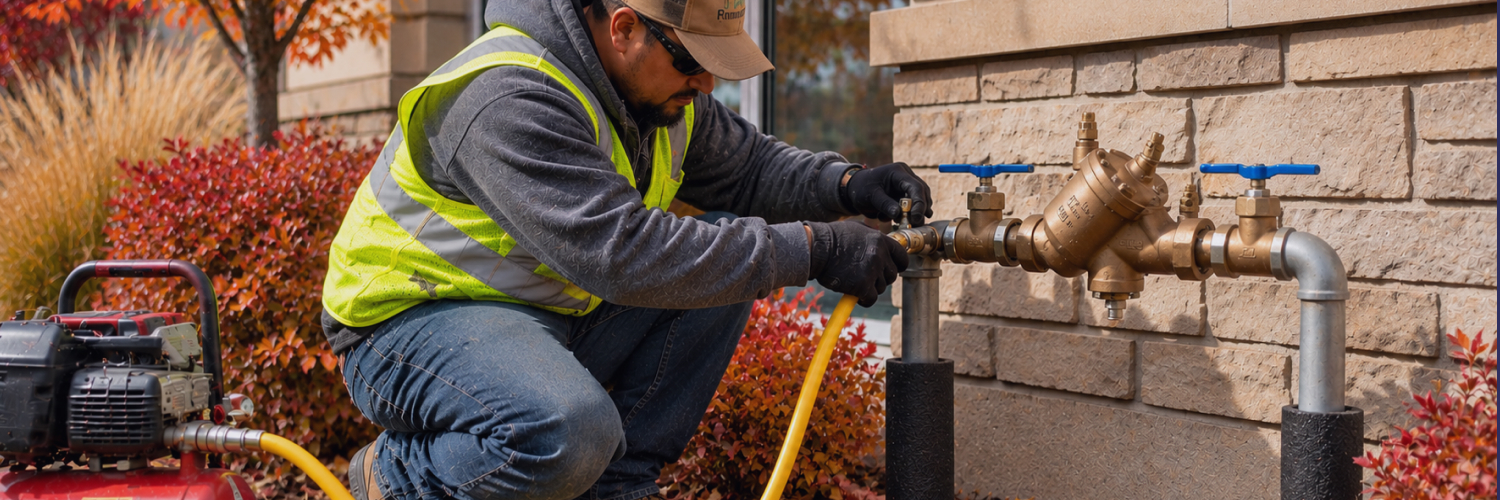
Backflow preventer protection is next, and it’s one of the most commonly skipped steps. These devices sit above ground, often exposed, and a single hard freeze can crack the internal components even if the rest of the system was drained correctly. Insulating, removing, or storing the backflow preventer is not optional in any climate that sees a hard freeze, even a rare one.
Controller settings matter too. The shutdown isn’t complete until the controller is set to “rain mode” or powered down per manufacturer guidance, so a leftover watering schedule doesn’t trigger a cycle through an empty, frozen system.
And “done” should mean something specific on paper: a completion report confirming method per zone, backflow protection, controller status, and verification that no water remains in the lines, not just a checked box that says “winterized.”
Sequencing Shutdown Across a Portfolio by Climate Zone
For a single site, shutdown is a task. Across a portfolio, it’s a schedule that has to follow climate, not one calendar date applied everywhere. Northern sites should close first, well ahead of the first realistic freeze date, but not so early that turf goes without water it still needs. Sun Belt sites typically move to a reduced watering schedule instead of a full shutdown. Western sites carry a different variable: watering restrictions and drought rules that govern timing independent of temperature, checked site by site (more in Commercial Property Landscaping in a Drier West [LINK TBD] and How Snow Droughts Impact Landscaping).
Since October 1, Lessen has managed nearly 1,000 irrigation shutdown work orders across USDA hardiness zones 4 through 10. More than 90% of that volume falls in zones 5 through 8, where hard freezes are a given and a full shutdown is non-negotiable. Zones 9 and 10 account for only about 5%, because sites there typically shift to a reduced watering schedule instead. The work follows the climate, not the calendar, and that's the logic a portfolio-wide schedule should follow.
This is the same argument we’ve made in From Patchwork Services to Portfolio-Wide Strategy: consistency across a portfolio comes from a plan, not from however each site’s vendor happens to operate.
The Cost of a Skipped or Rushed Shutdown
A cracked pipe from a hard freeze is rarely the whole cost. A failed backflow preventer is a code-compliance issue, often requiring recertification before the system can legally run again in spring. Emergency commercial irrigation repair in winter costs more than scheduled fall work: urgency, limited crew availability, no time to shop the work. And a damaged system means a delayed spring startup while parts are sourced, pushing your green-up date back right when curb appeal starts to matter.
Across the sites Lessen manages, freeze damage accounted for zero spring repair work orders last season, because every system was shut down correctly and on schedule before the first hard freeze. That result isn't luck or a mild winter. It's what a planned, verified shutdown produces, and it's the clearest evidence that freeze damage is a scheduling problem, not a weather problem.
We’ve covered the broader economics of reactive versus planned work in Controlling Costs in Landscaping, what planned programs cost in Commercial Landscape Maintenance Pricing [LINK TBD], and how aging irrigation infrastructure played out at scale in A Decade of Growth. The irrigation-specific version is simple: a shutdown is a fixed, predictable cost. A freeze failure is not.
The Handoff: What to Check Before Crews Switch from Landscaping to Snow
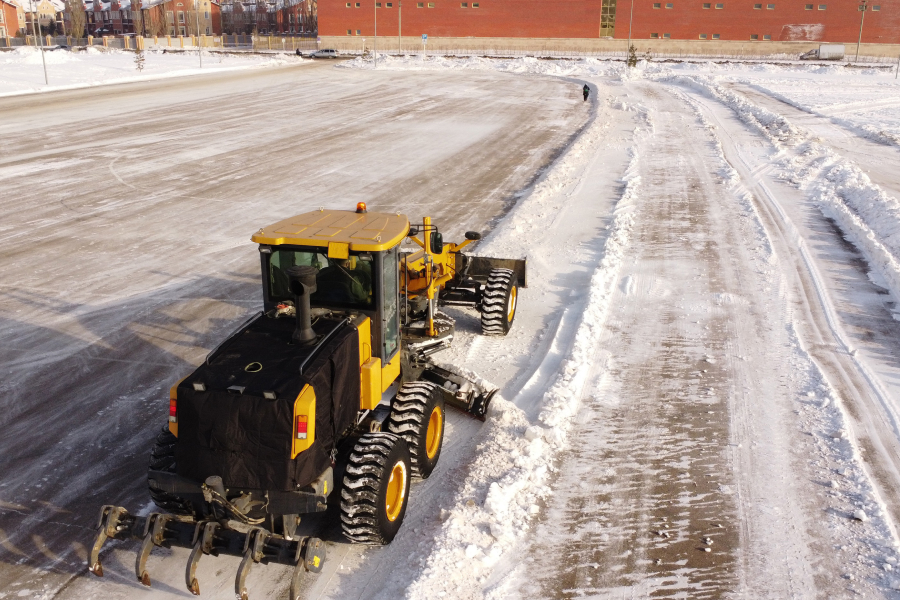
At most commercial properties, the footprint landscaping crews maintained all year becomes a snow crew’s territory within weeks. Before that handoff, confirm irrigation heads are retracted or marked so plow blades and shovels don’t catch them, valve boxes are visible or flagged so they aren’t buried under snow stacking, and the backflow preventer’s location is noted for any de-icing crew nearby. A shutdown that’s technically complete but invisible to the next crew is still a liability waiting for a plow blade.
Quick-Reference Shutdown Checklist
For a fast gut check across your sites:
- Shutdown method selected per site (blowout or manual drain) based on system design
- Backflow preventer insulated, removed, or otherwise protected
- Controller set to rain mode or powered down
- Completion report on file, documenting method, backflow protection, and controller status per zone
- Shutdown timing matched to climate zone, not a single company-wide date
- Sun Belt and western sites confirmed on the correct reduced or restricted watering posture
- Irrigation heads and valve boxes marked or flagged before snow crews take over
How ONE by Lessen Keeps Shutdown on Schedule
Grounds maintenance across a large portfolio is a scheduling problem as much as a technical one. With ONE by Lessen, every site’s shutdown is planned into the season calendar by climate zone, and vendors confirm completion with photo-verified, time-stamped reports. Your team can see which sites are finished and which are still open in one place, without chasing individual vendors, and the whole program runs on one contract and one invoice.
Lessen’s commercial landscape maintenance network includes more than 750 landscaping providers managing work across roughly 6,000 sites, with planned work completing on schedule more than 97% of the time. That coverage is also why irrigation shutdown works better as part of a season-long plan under one invoice, an approach covered in full in How Transparency and Ease Build Better Landscaping Programs.
A milder winter on average is not a reason to loosen up on shutdown. It’s a reason to make sure the one freeze that does arrive finds every site ready for it.
Talk to our team to get your shutdown scheduled by climate zone before the first hard freeze hits.
Sources – NOAA, 2026-2027 U.S. Winter Outlook: https://www.noaa.gov/news-release/el-nino-looms-large-over-us-winter-outlook
Ready to see it in action?
Tell us how your portfolio runs today, and we'll show you exactly where Lessen fits.