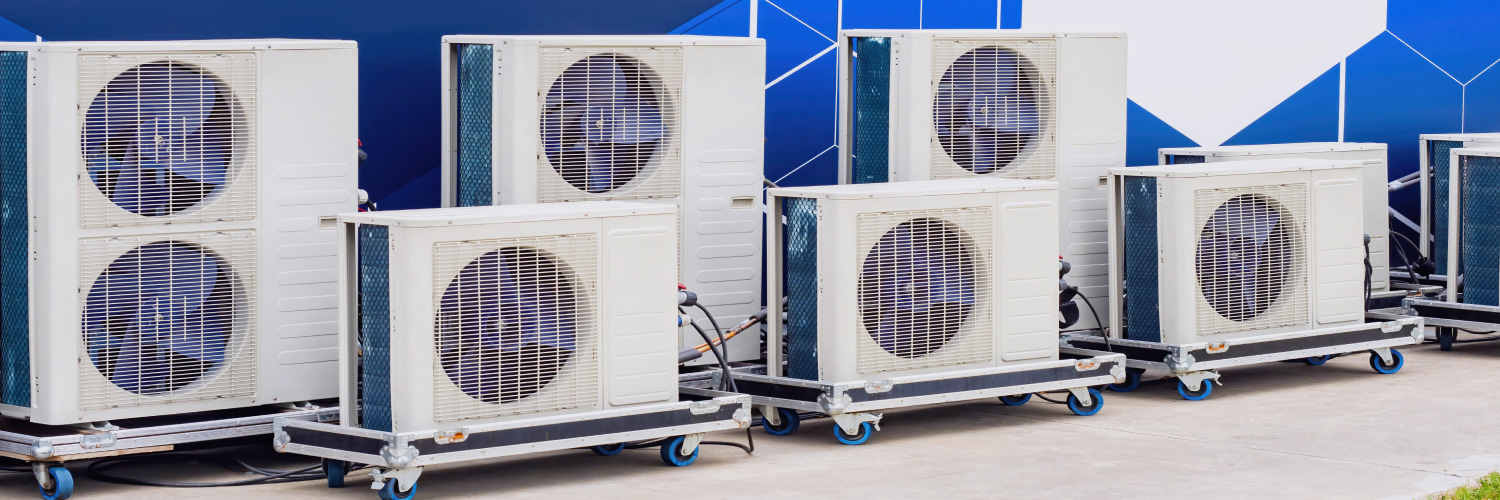

A large national retail bank partnered with Lessen to bring discipline to a quietly expensive line item — temporary HVAC units, portable restrooms, and air scrubbers deployed during repairs. By tightening the process around when temporary units go in, how they're tracked, and when they come out, the bank cut its Temp Unit Management spend by 56% in 2025 compared to 2024.
Background and pain points
Like most national branch networks, this bank occasionally needs temporary HVAC units, portable restrooms, and air scrubbers to keep locations operational while repairs are under way. Left unmanaged, that spend compounds quietly: a unit stays in place after the underlying repair is finished, or a location racks up temporary unit costs over several months while a longer-term fix works through approval. During Quarterly Business Reviews, Lessen began surfacing temporary unit expenditures by location that were still pending project approval — and in some cases, cumulative spending across the year was approaching the cost of installing a permanent replacement unit outright.
That visibility raised a straightforward question: how much of this spend was actually necessary, and how much was the byproduct of a process that didn't have clear checkpoints for prioritizing repairs, reassigning responsibility, or removing a unit the moment it was no longer needed?
Creating new efficiencies
Lessen and the bank built a four-part approach to bring temporary unit spend under control without compromising comfort or operations during repairs.
Process improvement
Repairs associated with eachtrade are now reviewed and prioritized before any temporary unit is deployed,so a unit goes in only when it's the right call — not the default one.
HVAC optimization
The team uses the bank's own EMS (energy management system) to adjust temperature settings during repairs, maintaining employee and customer comfort without always requiring a standalone temporary unit.
Collaboration and communication
Lessen documents the root cause of each issue and flags when responsibility sits with another party — a landlord, a warranty provider, or an external vendor — then engages that party directly to provide a replacement unit, rather than letting the cost default tothe bank's R&M budget.
Technology integration
Technology flags the team the moment a repair is completed at a location with a temporary unit deployed, so Lessen can verify current site conditions, confirm whether the unit is still needed, and remove it immediately — preventing unnecessary billing for equipment that's no longer doing a job.
Budget reallocation and ongoing collaboration
During Quarterly Business Reviews, Lessen shares temporary unit expenditures by location that are pending project approval, giving the bank visibility into spend before it becomes a bigger problem. In Q3 2024, Lessen and the bank's team worked together to demonstrate the R&M savings available if temporary unit expenses were included as part of a project's statement of work — allowing those costs to be properly categorized under the capital project itself, rather than absorbed as ongoing R&M spend.
That collaboration continues on a monthly cadence: Lessen reviews problematic locations with the bank's projects team to assess pending capital expenditure approvals, advising thebank on current break-fix and temporary unit spend relative to approved CapEx projects already in motion.
Key takeaways
- Temp Unit Management spend — HVAC temporary units, portable restrooms, and air scrubbers — fell 56% in full-year 2025 compared to full-year 2024.
- A four-part process (prioritization, EMS-based HVAC optimization, responsible-party engagement, and automated removal triggers) replaced an unmanaged, default-to-deploy approach.
- Quarterly and monthly reviews now give the bank ongoing visibility into temporary unit spend against pending CapEx approvals, instead of surfacing costs only after they've accumulated.
- Temporary unit costs tied to capital projects can now be categorized under the project's SOW rather than carried as standalone R&M expense.
Results reflect this client's specificprogram and are not presented as a vertical-wide benchmark.