
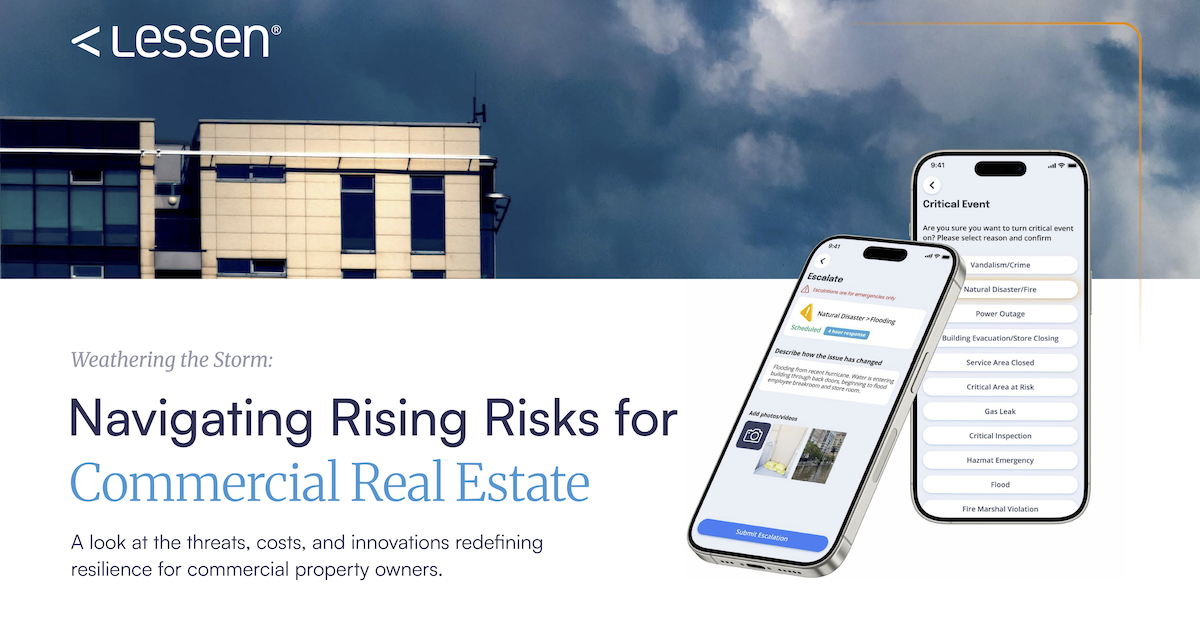
Weathering the Storm: Navigating Rising Risks in
Commercial Real Estate
How prepared is your portfolio for the next disruption? Lessen’s data-driven analysis reveals how environmental volatility, aging infrastructure, and insurance shifts are reshaping risk and resilience across the property landscape.
For property owners and operators, extreme weather has become a defining operational
challenge. Each year, storms, floods, and wildfires drive billions in damages, downtime,
and lost revenue. Yet most portfolios lack clear visibility into their true exposure—or the
strategies that protect performance when disaster strikes.
Drawing from national data and expert insights, Weathering the Storm examines where
risk is growing fastest, how financial and insurance pressures are evolving, and the
tools top-performing teams are using to prepare, respond, and recover with speed and
confidence.
What's Inside?
- Where and how natural disasters are reshaping commercial real estate across asset classes from retail and healthcare to logistics and telecom
- The real financial impact: repair ranges, downtime costs, and insurance trends across high-risk regions
- How insurance, valuation, and lending standards are evolving in response to climate volatility
- Technology shaping next-generation resilience—digital twins, AI risk modeling, IoT monitoring, and automated compliance tools
- Centralized disaster response and automation frameworks improving communication, claims processing, and time-to-reopen
Key Takeaways:
- The U.S. experienced 27 billion-dollar climate events in 2024, proof that volatility is now a baseline operating condition
- Over $150B in annual losses and $54B in revenue disruption demonstrate the scale of CRE exposure
- Nearly 730,000 commercial and multifamily properties face flood risk, with repair costs projected to rise 25% by 2052
- Properties leveraging AI-driven assessments and automated compliance tools report faster recovery and 25% fewer penalties than peers
- Centralized communication and predictive maintenance tools materially reduce downtime and insurance friction
- This is my list